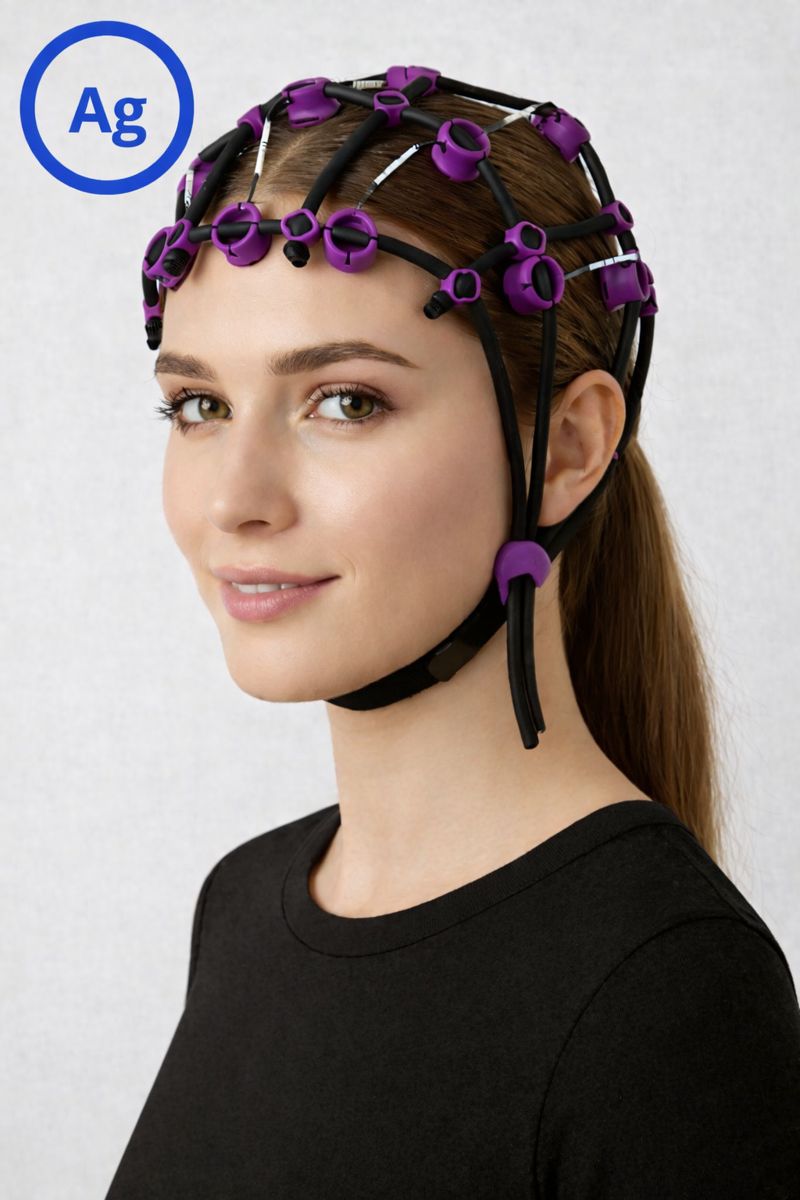
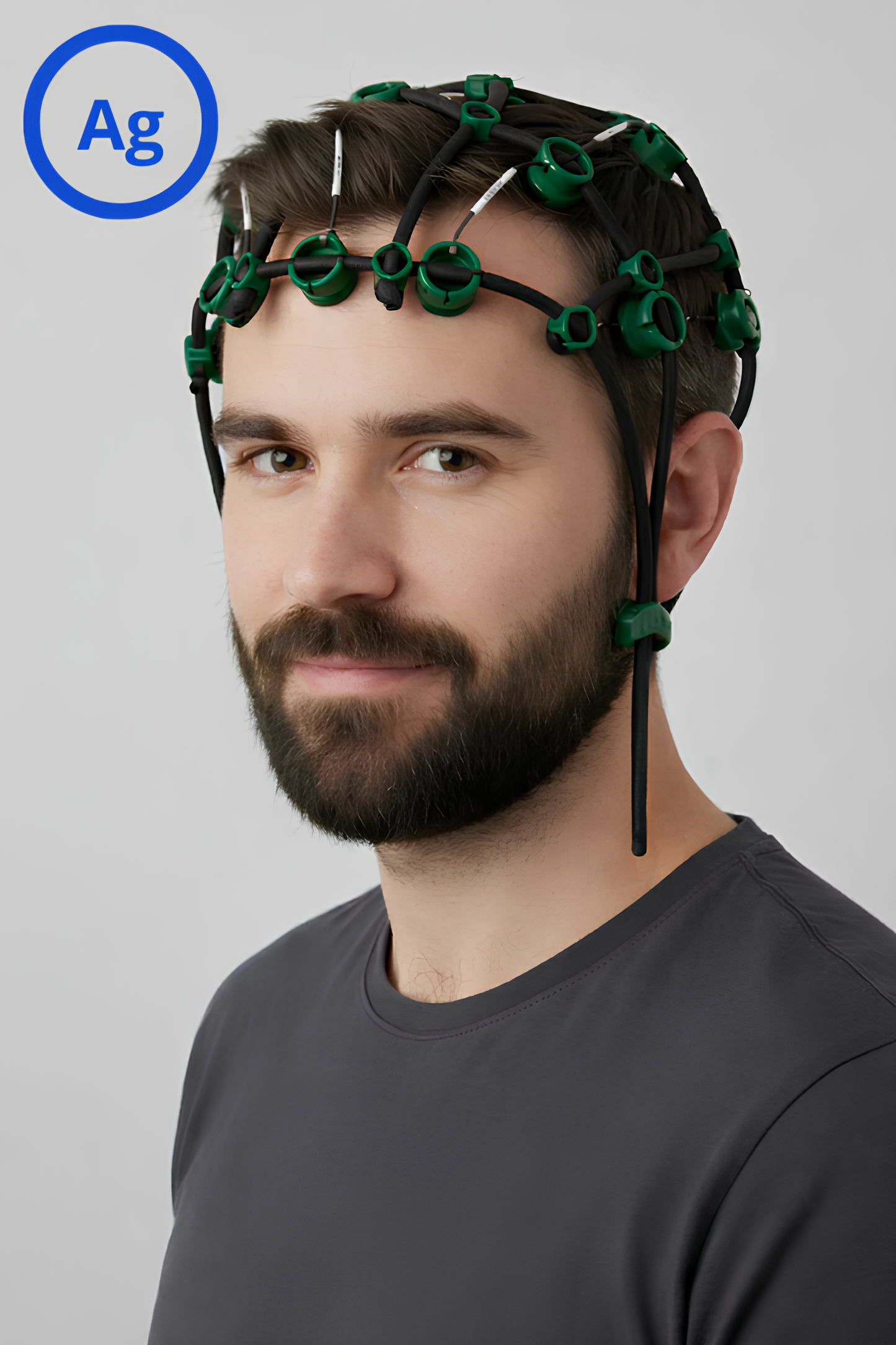
which are an integral part of the system, this EEG cap is particularly well suited for reliable EEG recordings and neurofeedback training. The pads absorb and store the saline solution required for these applications. As they remain moist, stable conductivity between the electrodes and the scalp is ensured. This keeps impedances low and constant, and signal recording remains stable. In addition, the Peak Pads adapt optimally to the electrode holders.
Free-Cap – 19-channel EEG/QEEG cap, semi-dry, Ag
Free-Cap – 19-channel EEG/QEEG cap, semi-dry, Ag
Couldn't load pickup availability
Low stock
Delivery time approx. 1-4 working days

Transparent VAT regime for EU business customers
Transparent VAT regime for EU business customers
All prices include 19% German VAT. For business customers from the EU, VAT will be automatically removed at checkout after entering a valid VAT ID number (reverse charge).
Do I need to wash my hair after the training?
No. Since the Free-Cap works exclusively with a light saline solution, no sticky residues are left behind. This is ideal for clients who have appointments directly after training.
Do I need special accessories for the Free-Cap?
No, you only need conventional table salt and tap water to prepare the electrolyte solution.
Is the cap also suitable for children?
Yes, thanks to the flexible adjustment options and the absence of sticky gel, acceptance among children is significantly increased.
Why is it useful to have different EEG caps?
People have different head sizes and shapes, so different cap sizes ensure a good fit and stable electrode contact. A poorly fitting cap can lead to measurement errors or signal noise.
For saline semi-dry electrodes, the saline solution-moistened electrodes dry out over time and the signal quality decreases. Having multiple caps allows one to be prepared anew while another is still in use, enabling quick changes and consistently high data quality.
Which EEG cap sizes are recommended for adult participants?
The sizes are based on head circumference:
- S (47–52 cm): for smaller head sizes
- M (52–57 cm): suitable for most women and small to average men
- L (57–62 cm): suitable for most men and larger heads
In practice, most women need size M and most men need size L. However, it is important to keep at least one small cap (S) on hand to ensure correct electrode placement according to the international 10–20 system.
How should the daily handling of sponge electrodes (saline semi-dry) be organized?
At the beginning of the day, several sets of sponges are prepared in saline solution. A fresh set is used for each person. At the end of the day, all sponges are cleaned and air-dried.
This ensures:
- stable and low impedances
- good hygiene between applications
- long-term good contact quality and comfort
How is the hygiene of the EEG caps ensured?
The caps can be cleaned with a mild disinfectant or hand-washed if necessary. With good ventilation, they usually dry within about 30 minutes.
Which accessories are recommended for optimal use?
Recommended accessories include:
- Peak Pads (10–30 depending on use)
- Skin preparation gel and cotton swabs
- Saline solution or salt tablets
- Pipettes and spray bottle
- Spare parts such as chin strap and electrodes
How long do EEG caps last and how can their lifespan be extended?
With proper care, caps last about 100–200 sessions or 1–2 years. Rotating multiple caps, thorough cleaning, and complete drying significantly extend their lifespan. In addition, a standardized 0.9% saline solution should be used to avoid material damage.
What makes Free-Cap Peak Performance special?
Silver electrodes (Ag), peak pads and electrode holders

Thanks to the Peak Pads,

Thanks to the flexible design of the electrode holders
the electrodes adapt to different head shapes, ensuring reliable contact while maintaining the 10-20 system.

Thanks to the double-layered design of the chin strap
the wearing comfort is significantly improved. One side consists of a thin, sponge-like textile material, the other of soft hook-and-loop material. The double seam ensures additional durability, and the soft material guarantees a pleasant, soft wearing experience.

Here's what our customers say about Free-Cap:
Amy Warren
A fantastic invention... I have the highest praise for the Free-Cap. Once you've used it, I can't imagine ever wanting to go back to the glue method. In my experience, the connectivity is better, even with ISF. I've found it works well on all hair types. Both clients and technicians are thrilled.
Dr. Robert W. Thatcher, Ph.D., CEO Applied Neuroscience, Inc.
Thomas Feiner's EEG caps are a new, excellent, and necessary innovation. The cap is easy to put on and comfortable. A unique feature is the ability to simultaneously record the EEG while applying stimuli and other treatment modalities .
Dr. Dick Genardi, Ohio
... Neurofeedback practitioners need to be aware of this cap, especially those performing whole-head assessments, 19-channel measurements, and Loreta.
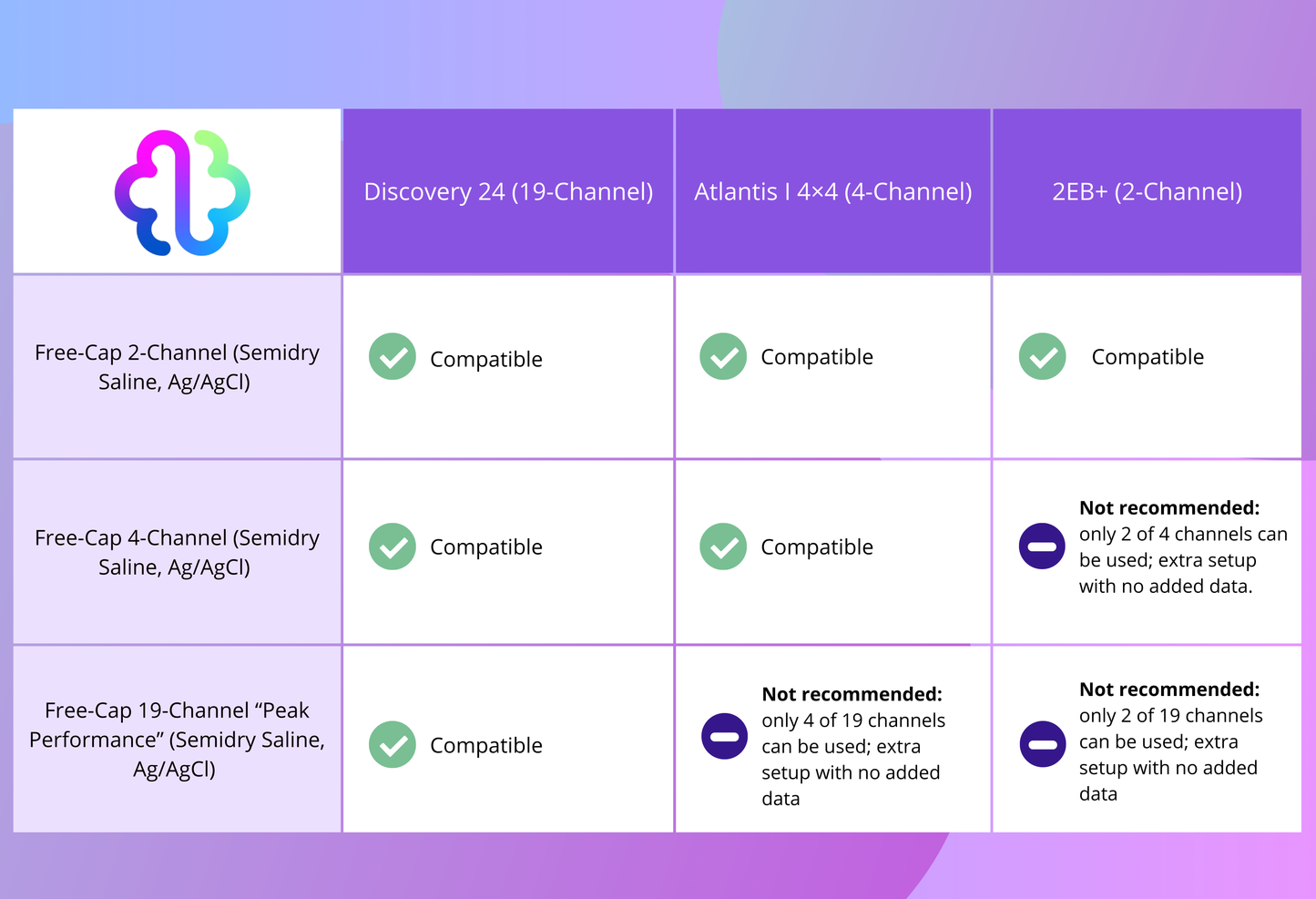
The Free-Cap is so much faster to use, easier to achieve good low impedances, and much more comfortable for the patient. It's also an advantage with 4 channels or fewer. I have a DBA, so I can use your full-cap version with my Atlantis.
What I particularly like is that I can lift the electrode, apply NuPrep and put the electrode back, and the impedance drops - without the patient feeling uncomfortable.
I hope your cap is a success. You deserve to make a lot of money with it. A great contribution.
Dr. Doron Todder
I really like the cap and you get a great signal in no time!