Skip to product information
1 of 4

Easter Special Offer: Free-Cap Peak Performance – 2-channel EEG/QEEG cap, semi-dry, Ag/AgCl

Easter Special Offer: Free-Cap Peak Performance – 2-channel EEG/QEEG cap, semi-dry, Ag/AgCl

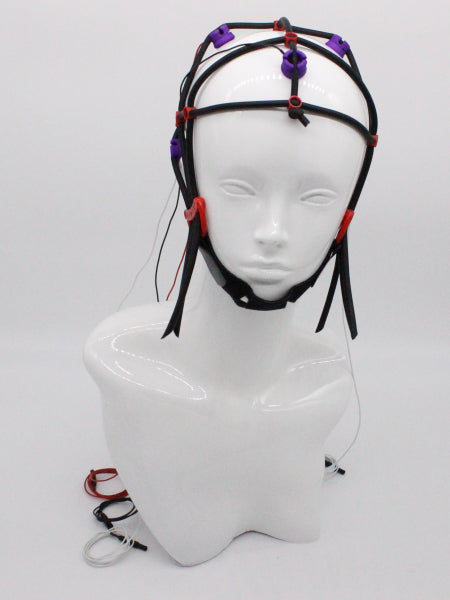
TheFree-Cap Peak PerformanceThis EEG/QEEG cap (network system) with silver/silver chloride (Ag/AgCl) electrodes allows for the measurement of electrical brain activity without the use of gels or pastes. The use of a silicone tube makes the system particularly comfortable to wear, and many users describe it as very comfortable.

The electrolyte is a simple saltwater solution, which is applied via specially designed sponges (Peak Pads) supports continuous humidity and thus promotes reliable contact quality throughout the measurement period.

Many users report that they quickly reach a good impedance range – this can significantly reduce preparation time.

The Free-Cap was developed and patented by Thomas Feiner.

Haftungsausschluss

Die Free-Cap ist kein Medizinprodukt im Sinne der EU-Verordnung (EU) 2017/745 (MDR).
Nicht zur Diagnose, Überwachung, Behandlung oder Prävention von Krankheiten bestimmt. Dieses Produkt dient ausschließlich nicht-medizinischen Zwecken und ist für nicht-diagnostische, nicht-therapeutische kognitive Assessments, nicht-therapeutisches kognitives Training sowie zur Unterstützung von Wellness, Entspannung, Forschung und Bildung vorgesehen.

Please make your selection first

In stock

Lieferzeit ca. 1-4 Werktage

Transparente MwSt.-Regelung für EU-Geschäftskunden

Alle Preise inkl. 19 % deutscher MwSt. Für Geschäftskunden aus der EU wird die MwSt. im Checkout nach Eingabe einer gültigen USt-IdNr. automatisch entfernt (Reverse-Charge).

View full details
  • Produktinformationen
  • FAQ
  • Lieferumfang

The Free-Cap Peak Performance (also called saline EEG cap or Free-Cap) was developed and patented by Thomas Feiner, QEEG-D and founder of the Institute for EEG Neurofeedback. It uses peak pads soaked in saline solution to improve conductivity between the scalp and electrodes – entirely without gel or paste.

The Free-Cap has been tested by neuroscientists and supported by published research.

Your advantages:

- Clean application:No sticky residue in the hair – clients can then return directly to their daily routine.

- Quick preparation:Saltwater electrolyte and peak pads enable quick assembly.

- Reliable impedance control:Fast and stable achievement of optimal impedance values ​​for EEG/QEEG measurements

- High flexibility:Freely movable electrode holders for 1 to 19 channels according to the international 10-20 system

- High wearing comfort:soft sponge materials, elastic bands and comfortable guidance thanks to silicone tubing material

- Durable and sustainable:Components are individually replaceable, enabling long-term economical use.

- Wide compatibility:Compatible with many common systems (e.g., BrainMaster, Q20, Cognionics CAMP, Mitsar); depending on the system, a suitable adapter or cable may be required.

We will gladly advise you on any questions regarding compatibility with your amplifier.

Areas of application:

- Neurofeedback training (SCP, ISF, ILF, QEEG)

- Cognitive assessment, cognitive training, relaxation, wellness and research

Free-Cap Peak Performance is versatile and widely applicable. Customers worldwide – including in the USA, Germany, Spain, Portugal, India, and Puerto Rico – already use our technology. It is particularly suitable for applications in cognitive training, assessment, research, and education.

Do I need to wash my hair after training?

No. Since the Free-Cap works exclusively with a light saline solution, no sticky residue is left behind. This is ideal for clients who have appointments immediately after training.

Do I need special accessories for the Free-Cap?

No, you only need conventional table salt and tap water to prepare the electrolyte solution.

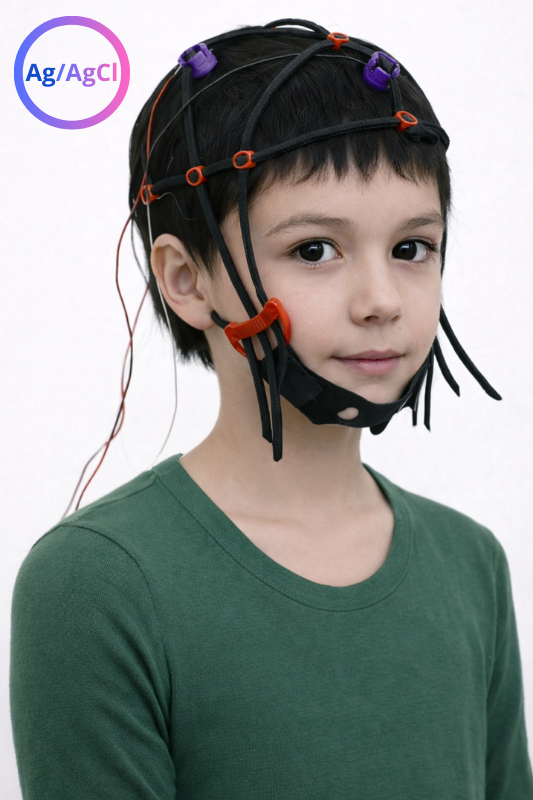
Is the cap also suitable for children?

Yes, the flexible adjustment options and the absence of sticky gel significantly increase acceptance among children.

Why is it useful to have different EEG caps?

People have different head sizes and shapes, so different cap sizes ensure a good fit and stable electrode contact. A poorly fitting cap can lead to measurement errors or signal noise.

With saline semi-dry electrodes, the saline-soaked electrodes also dry out over time, and signal quality decreases. Having multiple caps allows one to be prepared while another is still in use, enabling quick changes and consistently high data quality.


Which EEG cap sizes are recommended for adult participants?

Sizes are based on head circumference:

- S (47–52 cm): for smaller head sizes

- M (52–57 cm): suitable for most women and smaller to average men

- (57–62 cm): suitable for most men and larger heads
In practice, most women need size M and most men need size L. However, it is important to have at least one small cap (S) available to ensure correct electrode placement according to the international 10–20 system.

How should daily handling of sponge electrodes (saline semi-dry) be organized?

At the beginning of the day, several sets of sponges are prepared in saline solution. A fresh set is used for each person. At the end of the day, all sponges are cleaned and air-dried.

This ensures:

- stable and low impedances

- good hygiene between applications

- long-term good contact quality and comfort


How is the hygiene of the EEG caps ensured?

The caps can be cleaned with a mild disinfectant or hand-washed as needed. With good ventilation, they usually dry within about 30 minutes.

Which accessories are recommended for optimal use?


Recommended accessories include:

- Peak Pads (10–30 depending on use)

- Skin preparation gel and cotton swabs

- Saline solution or salt tablets

- Pipettes and spray bottle

- Spare parts like chin straps and electrodes

How long do EEG caps last and how can their lifespan be extended?


With proper care, caps last approximately 100–200 sessions or 1–2 years. Rotating multiple caps, thorough cleaning, and complete drying significantly extend their lifespan. Additionally, a standardized 0.9% saline solution should be used to avoid material damage.

  • 1 net cap
  • 5 electrode holders
  • 5 electrodes made of sintered silver/silver chloride (Ag/AgCl)
  • 10 sponge pads
  • 1 chin strap
  • Dinc, L., Rybski, D., & Dineen, J. (2025). The effects of alpha/theta neurofeedback on mood, anxiety, emotion regulation and trait impulsivity.Brain Research.Article
  • Pérez-Elvira, R., Rodríguez Ledo, CR, Salgado-Ruiz, A., Agudo Juan, M., Quiroga Méndez, P., Dragomir, A., Costea, R., & Neamțu, B. (2024). EEG Activation During a Mindfulness Session and Its Effects on Memory Encoding.NeuroRegulation, 11(2), 112-127.Article
  • Collura, TF, Keizer, AW, Perez-Elvira, R., Warner, S., & Feiner, T. (2023). Electroencephalographic imaging and biofeedback training using Z-scores: Databases and LORETA-based methods. InIntroduction to Quantitative EEG and Neurofeedback(pp. 35–61). Elsevier.Book chapter

Was macht Free-Cap Peak Performance Besonders?

Silberelektroden (Ag), Peak-Pads und Elektrodenhalter

Fügen Sie hier Ihren Content hinzu

Dank der Peak Pads,

die integraler Bestandteil des Systems sind, eignet sich diese EEG-Haube besonders gut, da sie die für Aufzeichnungen und kognitives Training erforderliche Aufnahme und Speicherung der Kochsalzlösung ermöglichen. Dadurch bleiben die Impedanzen und die Signalaufzeichnung stabil, und die Haube passt sich optimal an die Free-Cap Peak Performance an.

Dank des flexiblen Designs der Elektrodenhalter

passen sich die Elektroden an unterschiedliche Kopfformen an, sodass unter Beibehaltung des 10-20-Systems ein zuverlässiger Kontakt gewährleistet wird.

Dank der doppellagigen Ausführung des Kinnriemens

wird der Tragekomfort deutlich verbessert. Eine Seite besteht aus einem dünnen, schwammartigen Textilmaterial, die andere aus weichem Klettmaterial. Die doppelte Naht sorgt für zusätzliche Haltbarkeit, und das weiche Material gewährleistet ein angenehmes, weiches Tragegefühl.